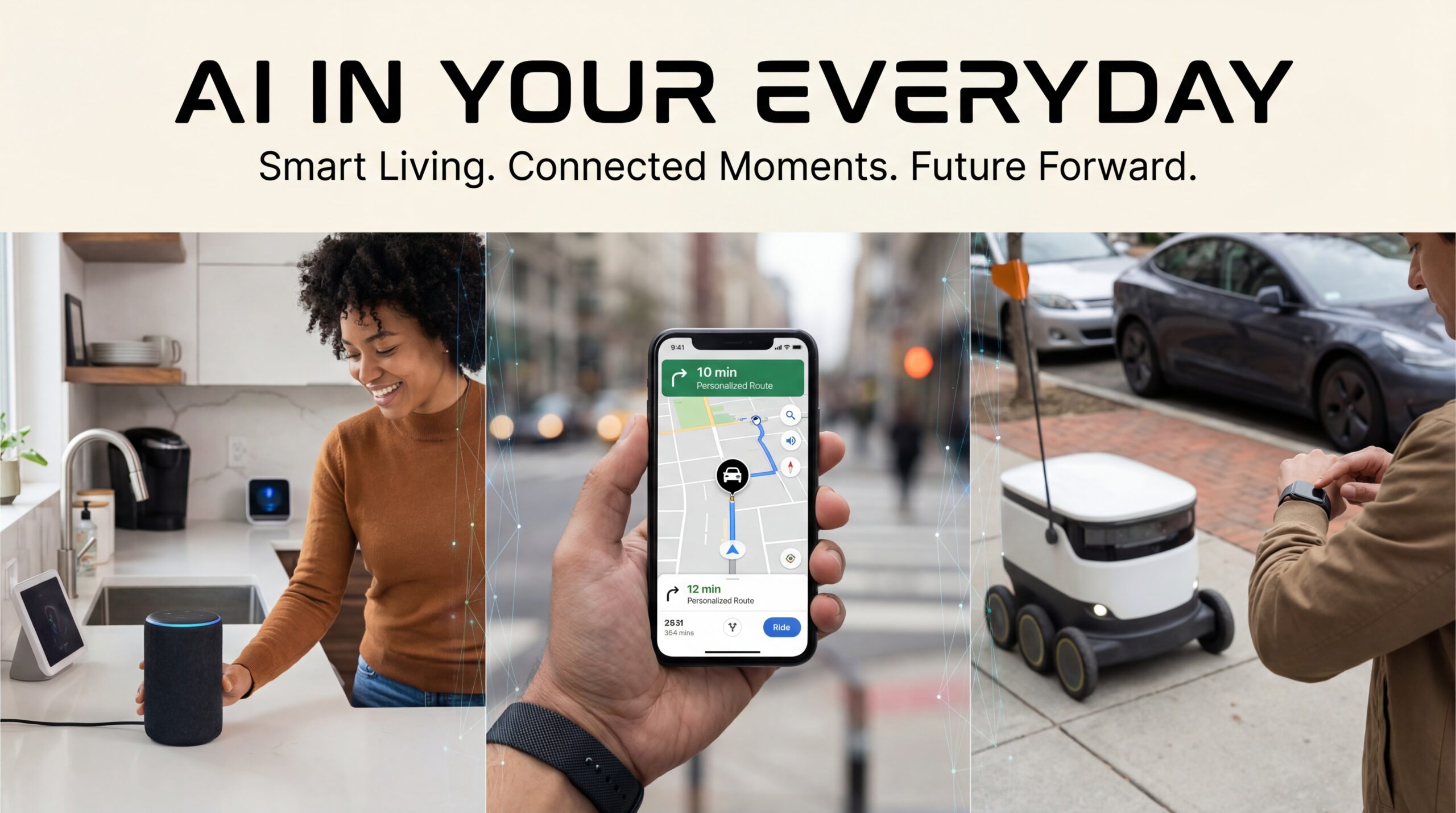
Artificial Intelligence didn’t arrive with fireworks.
No marching robots.
No dramatic takeover.
No moment where the sky cracked open and a voice said, “Welcome to the future.”
Instead, AI slipped in like humidity.
Slow.
Everywhere.
Hard to notice at first — until suddenly your whole day feels different.
That’s the part people miss.
AI didn’t change life in one big moment.
It changed hundreds of tiny moments — the kind you don’t tweet about, don’t notice, don’t question.
Until you stop and realize:
Oh. This thing is deciding more than I thought.
Let’s talk about how artificial intelligence is actually changing daily life — not the sci-fi version, not the hype version, but the ordinary, slightly unsettling, very real version we’re all living in.
AI Wakes Up Before You Do
Before your eyes open, AI is already busy.
Your alarm? Optimized.
Your weather app? Predicted.
Your traffic route? Calculated.
Your calendar reminders? Auto-suggested.
Even your phone knows when you usually wake up — and quietly adjusts battery usage around it.
That’s not magic.
That’s machine learning watching patterns.
And here’s the thing:
We don’t experience this as “AI.”
We experience it as convenience.
Which is exactly why it works.
Your Phone Knows What You’ll Type Before You Think It
Autocorrect used to be dumb.
Now it’s… unsettlingly accurate.
You start a sentence, and your phone finishes it like it’s inside your head.
That’s AI learning:
- How you speak
- What words you favor
- Who you talk to
- When you’re annoyed
- When you’re rushed
It’s not just predicting words.
It’s predicting you.
And yes — this saves time.
But it also shapes how we communicate.
Shorter sentences.
Predictable phrasing.
Less friction, less originality.
We’re not just typing with AI.
We’re slowly adapting to it.
AI Decides What You See (And What You Don’t)
This is the biggest change — and the one people underestimate the most.
Your social media feed isn’t chronological.
Your news isn’t neutral.
Your recommendations aren’t accidental.
AI decides:
- Which posts you see
- Which opinions feel “common”
- Which videos go viral
- Which ideas quietly disappear
Two people can search the same topic and live in completely different realities.
That’s not a glitch.
That’s the system.
AI doesn’t ask, “What is true?”
It asks, “What will you engage with?”
And engagement isn’t wisdom.
It’s reaction.
Shopping Is No Longer a Choice — It’s a Suggestion Engine
You didn’t decide to buy that thing.
It appeared.
At the right time.
In the right color.
At the exact moment you were vulnerable to buying it.
That’s AI-powered recommendation systems working quietly behind the scenes.
They know:
- When you hesitate
- What you almost buy
- What price makes you click
- What words make you trust
Online shopping has turned into a psychological mirror — reflecting desires you didn’t consciously express.
Impulse buying isn’t weakness anymore.
It’s design.
AI Is Changing How We Eat, Sleep, and Move
Fitness trackers don’t just count steps anymore.
They analyze:
- Heart rate variability
- Sleep stages
- Stress patterns
- Recovery cycles
They tell you:
- When to rest
- When to push
- When something feels “off”
That can be empowering.
It can also make people anxious — outsourcing intuition to data.
Instead of asking, “How do I feel?”
We ask, “What does the app say?”
AI doesn’t replace your body.
But it increasingly interprets it for you.
Navigation Apps Have Rewritten Our Sense of Direction
Ask yourself honestly:
Could you navigate your city without maps?
Most people can’t anymore.
AI-powered navigation systems decide:
- The fastest route
- Which streets you never explore
- Where traffic flows
- Which neighborhoods stay invisible
We don’t learn places the way we used to.
We follow instructions.
Efficient? Yes.
But something subtle is lost:
Spatial memory. Exploration. Serendipity.
We arrive faster — but know less.
AI Is Quietly Running Customer Service (And You Can Feel It)
Ever chatted with “support” lately?
You know that feeling when the responses are polite, instant, and slightly… hollow?
That’s AI.
It:
- Handles complaints
- Processes refunds
- Answers FAQs
- Filters angry customers
Sometimes it’s helpful.
Sometimes it’s infuriating.
Because AI is great at efficiency — and terrible at empathy.
You can’t guilt it.
You can’t pressure it.
You can’t exhaust it.
And that changes the power dynamic between companies and people.
Work Has Changed — Even If Your Job Title Hasn’t
AI didn’t “steal all the jobs.”
That narrative is lazy.
What it did do is change how work feels.
Emails are auto-written.
Reports are summarized.
Schedules are optimized.
Performance is tracked.
Productivity looks higher — but expectations quietly rise with it.
If AI helps you do more in less time, guess what happens next?
You’re expected to do more.
Efficiency never buys rest.
It buys higher targets.
Creativity Is No Longer a Human Monopoly
This one makes people uncomfortable.
AI can now:
- Write
- Draw
- Compose music
- Edit videos
- Generate ideas
Is it “creative” the way humans are?
That depends on how you define creativity.
But here’s the practical truth:
AI is now part of the creative process — whether people like it or not.
Some feel threatened.
Some feel empowered.
Most feel confused.
The real shift isn’t replacement.
It’s redefinition.
What does originality mean when tools can remix everything instantly?
We’re still figuring that out.
AI Has Changed How We Learn (And What Learning Means)
Search engines don’t just give answers.
They shape curiosity.
AI-powered tools:
- Summarize information
- Explain concepts
- Adapt to learning styles
- Predict what you’ll struggle with
That’s incredible.
It’s also dangerous if learning becomes passive.
Knowing how to find information isn’t the same as understanding it.
When answers are instant, patience disappears.
Depth becomes optional.
Dating, Relationships, and Human Connection Are Filtered Through AI
Dating apps are algorithms with emotions attached.
They decide:
- Who you see
- Who sees you
- When matches appear
- Which profiles get buried
Love, attraction, and chance encounters are now mediated by data.
Even messaging is influenced:
- Suggested replies
- Read receipts
- Online indicators
Romance didn’t disappear — but it became quantified.
Which is both fascinating and slightly tragic.
AI Is Shaping Opinions Without Debating You
This is subtle — and powerful.
AI doesn’t argue with you.
It doesn’t persuade loudly.
It nudges.
It repeats certain ideas.
It emphasizes certain angles.
It normalizes certain viewpoints.
Over time, those patterns feel like common sense.
Influence without confrontation is the most effective kind.
Smart Homes: Comfort at the Cost of Awareness
Lights that adjust automatically.
Thermostats that learn preferences.
Speakers that listen.
Smart homes feel futuristic — and they are.
They also normalize constant data collection.
Your habits become inputs.
Your routines become datasets.
Convenience increases.
Privacy becomes abstract.
Not gone — just quieter.
AI Has Changed Time Itself
This might sound dramatic, but think about it.
AI:
- Reduces waiting
- Speeds decisions
- Compresses processes
- Removes friction
Life feels faster — not because we move more, but because pauses vanish.
Silence is optimized away.
Boredom is filled.
Reflection gets crowded out.
When everything responds instantly, patience feels obsolete.
The Uncomfortable Truth: We’re Already Dependent
Try spending a full day without:
- Maps
- Recommendations
- Search
- Auto-suggestions
- Smart notifications
It feels… harder than it should.
Not because we’re incapable — but because systems reshaped habits.
Dependence didn’t arrive through force.
It arrived through comfort.
And comfort is persuasive.
Is This Good or Bad? That’s the Wrong Question
AI isn’t good or evil.
It’s amplifying.
It amplifies:
- Efficiency
- Bias
- Creativity
- Laziness
- Curiosity
- Control
Technology reflects the values of the systems that build and deploy it.
The real issue isn’t AI.
It’s who designs it, who controls it, and who benefits.
What Daily Life Might Look Like Next
More personalization.
Less randomness.
Fewer surprises — unless engineered.
Life becomes smoother… and narrower.
Unless people actively resist autopilot.
The Skill That Matters Most Now
Not coding.
Not engineering.
Awareness.
Knowing when:
- A suggestion is shaping a choice
- Convenience is trading off autonomy
- Efficiency is masking pressure
AI doesn’t need to dominate us.
But it will, quietly, if we never look up.