Let’s kill a myth first.
A viral post does not automatically mean money.
Millions of views can equal:
- $0 in revenue
- no brand deals
- zero long-term growth
And this is where most people get confused, frustrated, and suspicious.
You see someone go viral.
Then suddenly they’re “rich.”
So you assume the views did it.
They didn’t.
Monetization did.
Viral posts are not paychecks. They’re leverage. And influencers who understand this treat virality very differently from people chasing clout.
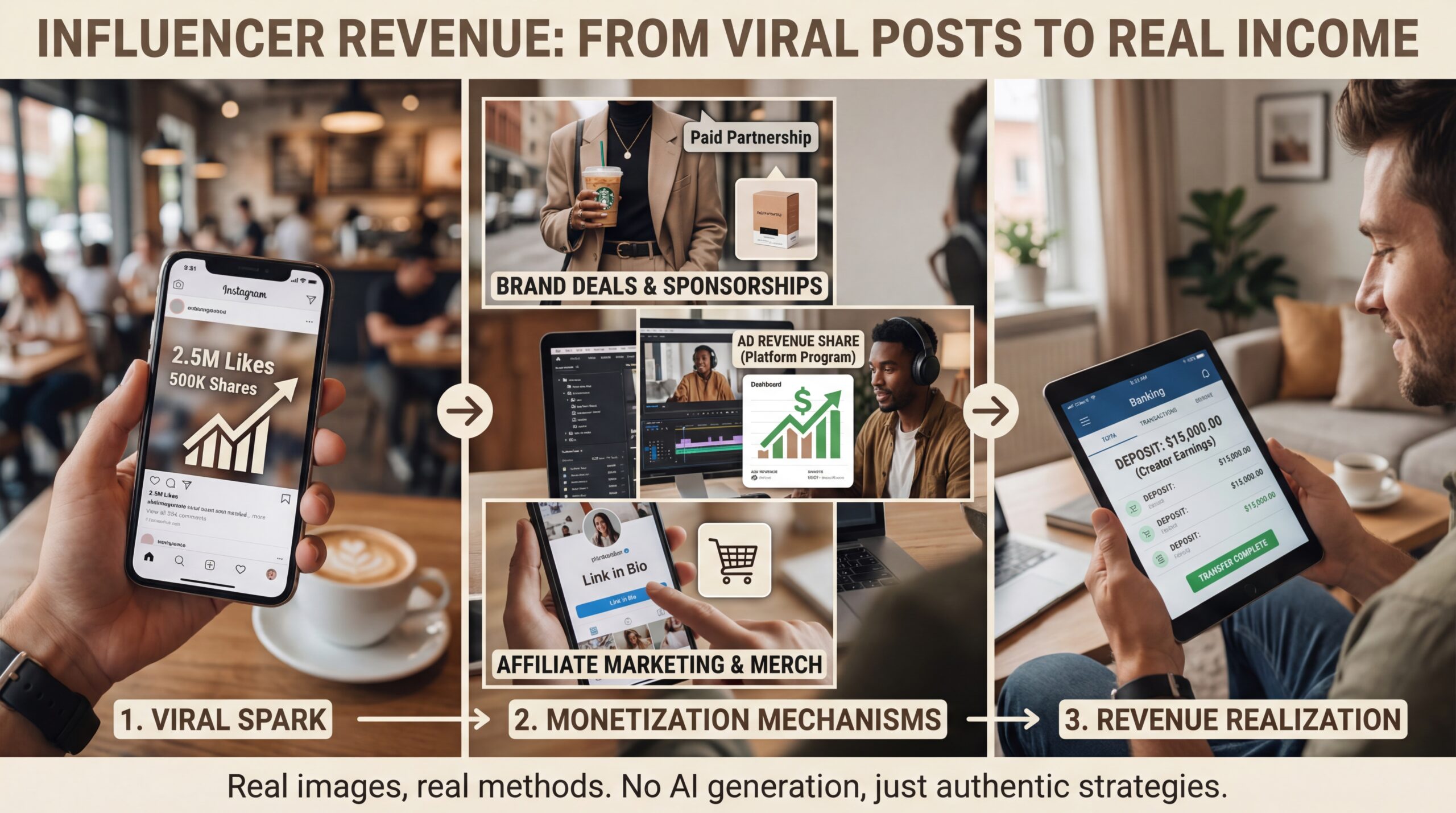
Let’s break down what really happens behind the scenes—how influencers turn short-lived attention into long-term income, and why most viral creators never make a dollar.
First: Viral Posts Are Attention Spikes, Not Businesses
Virality is a moment.
Income is a system.
Influencers who make money don’t celebrate views—they redirect them.
A viral post is like a crowd forming in the street. Everyone looks. Most keep walking. Smart influencers already know where they want that crowd to go.
If there’s no destination, the moment disappears.
This is why people go viral once and vanish.
And why others quietly build income from posts that never even hit a million views.
The #1 Rule Influencers Follow (That Beginners Miss)
Here it is, plain and brutal:
Money is made outside the viral post.
Not in the views.
Not in the likes.
Not in the comments.
The viral post is just the hook.
The money lives in:
- links
- funnels
- products
- emails
- brand relationships
Influencers who understand this prepare monetization before they go viral—not after.
1. Brand Deals: The Most Obvious (And Most Misunderstood)
Yes, brand deals are real.
Yes, viral posts attract brands.
No, brands don’t just throw money at anyone with views.
What brands actually look at
- audience demographics
- engagement quality
- niche relevance
- content style
- creator reliability
A viral meme account with random followers is less valuable than a niche creator with a smaller but targeted audience.
How influencers cash in
- brands reach out after a viral post
- influencers pitch brands using the momentum
- rates increase temporarily due to demand
But here’s the catch most people don’t realize:
Brand deals are rented income.
Stop posting, stop earning.
Smart influencers use brand deals as fuel, not foundations.
2. Affiliate Links: Quiet Money, Real Money
This is where many influencers make their most consistent income.
Instead of selling their own product, they recommend someone else’s—and earn a commission.
Why viral posts help
Viral content builds trust fast.
Trust increases conversions.
Conversions equal commissions.
A single viral post can:
- push thousands of people to a link
- generate sales for weeks
- revive old content
Why most creators fail at this
They promote without credibility.
They push products they don’t use.
They focus on the link instead of the story.
Successful influencers don’t sell products.
They sell decisions.
They frame the product as the obvious next step—not a desperate pitch.
3. Creator Funds & Platform Monetization (The Smallest Slice)
Let’s be honest.
Platform payouts are the weakest income stream.
Creator funds, ad revenue, bonuses—they sound exciting, but they rarely change lives unless you’re massive.
Why influencers still care
- it validates performance
- it adds supplemental income
- it signals value to brands
But no serious influencer relies on platform payouts alone.
It’s pocket money.
Not a business model.
4. Selling Their Own Products (Where the Real Power Is)
This is where viral posts become dangerous—in a good way.
Influencers who sell:
- courses
- templates
- ebooks
- presets
- communities
- coaching
can turn one viral post into months of income.
Why it works
No middleman.
High margins.
Full control.
A viral post can:
- flood an email list
- sell out a product
- validate an idea overnight
This is how creators turn attention into ownership.
The audience isn’t the asset.
The relationship is.
5. Email Lists: The Move Nobody Sees
This is the most boring, powerful tactic influencers use.
They move viral traffic off social media and into email.
Why?
Because platforms change.
Algorithms shift.
Emails stay.
A viral post is temporary.
An email list is leverage forever.
Smart influencers:
- offer a free resource
- tease exclusive content
- promise value beyond the platform
They don’t beg for follows.
They build escape routes.
6. Paid Communities & Subscriptions
When virality brings attention, loyalty brings money.
Some influencers monetize by:
- private Discords
- paid newsletters
- subscription content
- mastermind groups
The viral post attracts people.
The community keeps them.
This model works because:
- recurring income beats one-time deals
- smaller audiences can out-earn massive ones
- depth beats reach
A thousand loyal fans can outperform a million passive viewers.
7. Consulting, Coaching, and Services
Many influencers sell access.
After a viral post, people assume authority—even if the creator never claimed it.
Smart influencers channel that into:
- 1-on-1 coaching
- strategy calls
- audits
- consulting services
The viral post becomes proof.
The inbox becomes busy.
The calendar fills.
This is especially common in:
- business
- fitness
- marketing
- personal development
It’s not passive.
But it’s profitable.
8. Licensing & Repurposing Viral Content
This one flies under the radar.
Some influencers license viral content to:
- media companies
- brands
- platforms
- ad campaigns
Others repurpose viral ideas into:
- long-form YouTube content
- podcasts
- paid products
- speaking opportunities
The original post is just the seed.
The money grows elsewhere.
Why Most Viral Creators Stay Broke
Now the uncomfortable part.
Most people who go viral never make money because they:
- have no offer
- have no system
- have no follow-up
- chase validation instead of direction
They enjoy the moment.
They refresh analytics.
They screenshot views.
Then it’s over.
Virality without strategy is entertainment—not income.
The Psychology Influencers Understand (That Others Don’t)
Influencers don’t monetize views.
They monetize emotion.
Viral posts work because they:
- trigger curiosity
- spark relatability
- create desire
- cause frustration
- offer relief
Money flows when the next step matches that emotion.
If a post makes people feel:
- inspired → offer guidance
- confused → offer clarity
- motivated → offer tools
- frustrated → offer solutions
Mismatch the emotion, and conversion dies.
Timing Matters More Than People Think
Monetization works best immediately after virality.
Why?
Because attention decays fast.
Smart influencers:
- update bios instantly
- pin comments strategically
- add links immediately
- adjust CTAs in real time
They don’t wait to “set things up.”
They move while the spotlight is still warm.
Viral Posts Are Negotiation Chips
Here’s something most beginners don’t realize:
Influencers use viral posts as leverage.
They use screenshots and metrics to:
- raise brand rates
- secure long-term contracts
- attract partnerships
- validate pricing
One viral post can increase earning potential for months—even if it never makes money directly.
Visibility changes perceived value.
Not All Viral Posts Are Equal
This matters a lot.
Some virality attracts:
- the wrong audience
- low-intent viewers
- random traffic
Other virality attracts:
- buyers
- learners
- niche-specific followers
Influencers learn quickly which type pays—and double down on that.
Viral humor gets applause.
Viral problem-solving gets paid.
Why Influencers Don’t Chase Every Viral Trend
Contrary to popular belief, smart influencers are selective.
They skip viral trends that:
- attract irrelevant audiences
- dilute their positioning
- hurt long-term trust
They’d rather grow slower with alignment than faster with chaos.
Because monetization depends on who follows—not how many.
The Truth About “Selling Out”
People love to accuse influencers of “selling out.”
But monetization isn’t selling out.
It’s sustainability.
Free content costs:
- time
- energy
- creativity
Influencers who monetize well don’t ruin content.
They protect their ability to keep creating.
The bad ones sell anything.
The smart ones sell what fits.
The Real Influencer Income Timeline
Let’s ground this in reality.
Most influencers:
- create for months with no income
- go viral once with little payoff
- refine strategy
- monetize slowly
- then scale
The money comes after clarity—not before.
Viral posts speed things up.
They don’t replace the process.