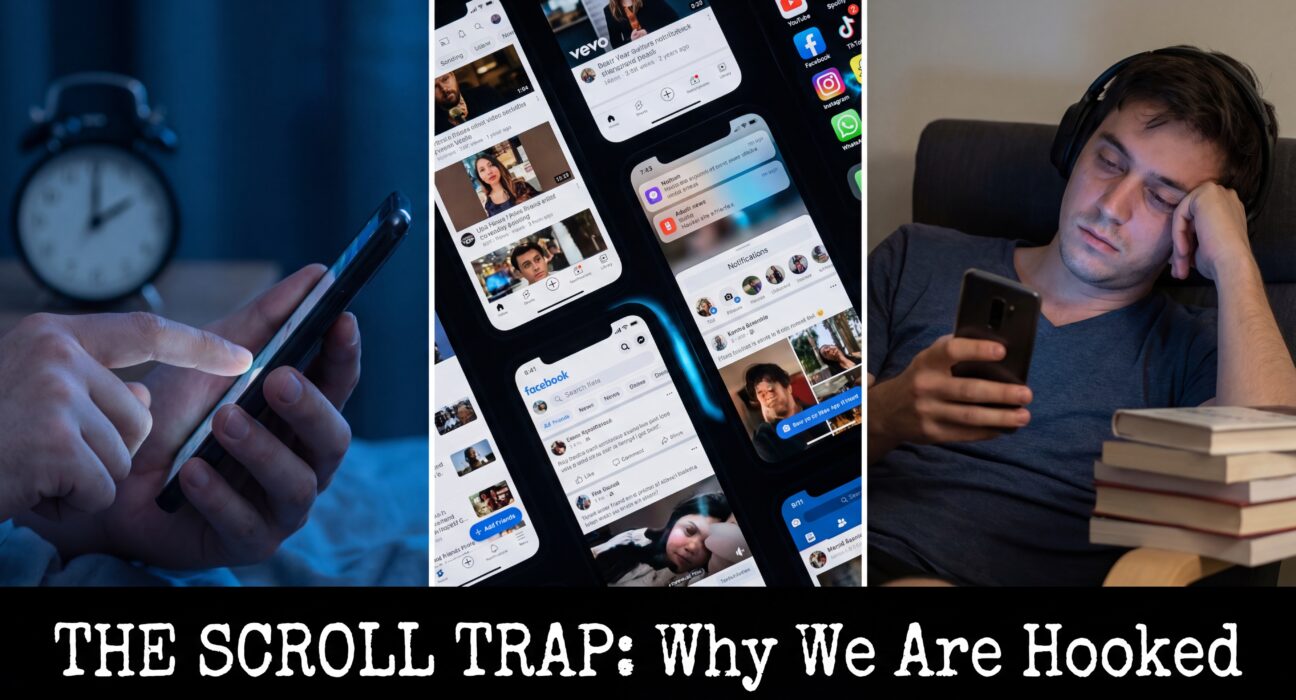
Let me guess.
You opened social media for “five minutes.”
An hour disappeared.
Your thumb hurts.
Your brain feels foggy.
You didn’t even enjoy most of what you saw.
And somehow, you’re annoyed at yourself.
That’s the trick.
We’ve been taught to frame endless scrolling as a personal failure—weak discipline, low focus, poor self-control. But that story is incomplete. Comforting. And wrong.
Because what’s happening isn’t accidental.
It’s engineered.
And once you understand why we can’t stop scrolling, the guilt starts to dissolve—and something more useful replaces it: clarity.
This Isn’t About Content. It’s About Control Loops.
People think they scroll because the content is “interesting.”
That’s surface-level thinking.
We scroll because social media taps directly into the most primitive systems in the human brain—the ones built for survival, novelty, and social belonging.
Scrolling isn’t entertainment.
It’s a behavior loop.
Here’s the loop:
- Anticipation
- Reward
- Uncertainty
- Repeat
The same structure used in slot machines. Same psychology. Different interface.
You’re not addicted to the content.
You’re addicted to the possibility that the next swipe will give you something better.
And occasionally, it does.
That unpredictability is the hook.
The Infinite Scroll Was a Psychological Nuclear Weapon
Before infinite scroll, there were natural stopping points.
Pages ended.
Videos finished.
You closed the app.
Then someone removed the bottom.
No “are you still watching?”
No friction.
No exit signal.
Your brain never gets closure.
It’s like a book with no last page—so your mind stays slightly unsatisfied, always chasing completion that never arrives.
Infinite scroll didn’t just increase engagement.
It removed the cue to stop.
And humans rely heavily on cues.
Without them, we default to momentum.
Dopamine Gets Blamed. Dopamine Isn’t the Villain.
Everyone talks about dopamine like it’s poison.
It’s not.
Dopamine isn’t pleasure.
It’s anticipation.
It’s the chemical that says:
“Something might be worth paying attention to.”
Social media is a dopamine slot machine:
- a funny video
- a shocking take
- a relatable post
- a like notification
Each one reinforces the loop.
But here’s the uncomfortable part: dopamine spikes before the reward—not after.
That means the scroll itself becomes more compelling than whatever you actually see.
Which explains something you’ve probably felt but never articulated:
You keep scrolling even when you’re bored.
That’s not weakness.
That’s biology being exploited.
Social Validation Is the Oldest Drug We Know
Long before likes and comments, humans survived in tribes.
Being accepted wasn’t a luxury.
It was safety.
Rejection could mean isolation.
Isolation could mean death.
Social media hijacks that ancient wiring.
Every like says:
“You’re seen.”
Every comment says:
“You matter.”
Every view says:
“You exist.”
Even when you’re not posting, you’re watching others be seen—and your brain quietly compares.
Am I falling behind?
Am I missing something?
Why is everyone else doing better?
Scrolling becomes a way to monitor your social standing—consciously or not.
You’re not just consuming content.
You’re scanning the tribe.
Fear of Missing Out Isn’t Fear — It’s Anxiety About Irrelevance
FOMO gets treated like a joke.
It’s not.
It’s the anxiety that life is happening without you.
Social media compresses time.
Events, trends, jokes, outrage—everything moves fast.
Log off for a day and suddenly:
- you don’t get the reference
- you missed the drama
- the trend is over
So you scroll not because you want to—but because you’re afraid of being out of sync.
The scroll becomes a form of vigilance.
Stay updated.
Stay relevant.
Stay included.
Exhausting—but compelling.
The Algorithm Knows You Better Than You Think
This part makes people uncomfortable.
The algorithm doesn’t just track what you like.
It tracks:
- what you pause on
- what you rewatch
- what you scroll past quickly
- what you watch late at night
- what makes you angry
- what makes you linger
It learns your emotional fingerprints.
Not who you say you are.
Who you actually are when no one’s watching.
Then it feeds that version of you back to you.
That’s why your feed feels eerily accurate sometimes—and deeply unsettling at others.
You’re not discovering content.
The content is discovering you.
Scrolling Is Emotional Regulation in Disguise
This is the part no one talks about honestly.
People don’t scroll because they’re happy.
They scroll because they’re:
- bored
- anxious
- lonely
- overstimulated
- avoiding something
Scrolling numbs edges.
It fills silence.
Distracts from discomfort.
Gives the illusion of movement when life feels stuck.
In that sense, scrolling is coping.
Not a healthy one—but a human one.
When people say “just stop scrolling,” it’s like telling someone to “just relax” during a panic attack.
You’re addressing the behavior, not the reason.
Time Feels Different on Social Media — And That’s Intentional
Ever notice how scrolling collapses time?
Ten minutes feels like two.
An hour feels like ten.
That’s not coincidence.
Social media removes:
- beginnings
- endings
- transitions
Your brain loses its temporal anchors.
No clear start.
No clear finish.
Just flow.
And when time dissolves, self-awareness weakens.
You don’t think:
“Should I still be here?”
You think:
“Just one more.”
Over and over.
Why Even Smart, Disciplined People Get Trapped
This is important.
Endless scrolling isn’t a sign of low intelligence or weak willpower.
Some of the most disciplined, successful people struggle with it the most.
Why?
Because high-performing brains:
- seek information
- crave stimulation
- process patterns quickly
Social media gives them endless input with zero effort.
It feels productive.
It feels like learning.
It feels like staying informed.
Until you realize you’re consuming without integration.
Input without output.
Noise without meaning.
The Illusion of Choice Keeps You Hooked
You feel in control while scrolling.
You choose what to watch.
You choose when to stop.
You choose who to follow.
But the choices are curated.
The menu changes based on your behavior.
The options narrow subtly.
The feed shapes your preferences over time.
It’s freedom with invisible rails.
That illusion of agency keeps you engaged longer than force ever could.
Why Logging Off Feels Weird (Almost Painful)
Have you ever logged off and felt… off?
Restless.
Empty.
Disconnected.
That’s withdrawal—not from content, but from stimulation.
Your brain has adjusted to constant input.
Silence feels loud.
Stillness feels wrong.
So you go back.
Not because you love the app.
Because your nervous system hasn’t recalibrated yet.
And that’s the cruel part:
The thing making you overwhelmed is also what temporarily soothes the overwhelm.
This Isn’t a Moral Failure. It’s an Attention Economy.
Here’s the reframing that changes everything:
Social media isn’t broken.
It’s doing exactly what it was designed to do.
Your attention is the product.
Your time is the currency.
Your behavior is the data.
Companies don’t profit when you feel fulfilled.
They profit when you stay.
Understanding that doesn’t make you superior.
It makes you aware.
And awareness is the first crack in the loop.
So… Are We Doomed?
No.
But pretending this is about “self-control” keeps us stuck.
Real change doesn’t come from deleting apps in a fit of guilt.
It comes from redesigning how—and why—we use them.
That means:
- recognizing emotional triggers
- creating friction intentionally
- setting stopping cues
- replacing scroll time with real regulation (walks, writing, silence, conversation)
Not perfectly.
Not forever.
Just enough to reclaim choice.