Buckle up, because we’re about to dive into a corner of internet culture that feels ephemeral, confusing, and, frankly, magical: aura farming and viral slang. If you’re a millennial or Gen-Z, you’ve probably felt it creeping into your feeds, your group chats, or even your DMs without really noticing. And if you’re not? Well, prepare to feel like you’re watching a foreign film with no subtitles—but in the most fascinating way possible.
This is how “vibes” online aren’t just a mood—they’re shaping culture, language, and even how we present ourselves to the world.
What is “Aura Farming,” and why is it everywhere?
Let’s start with the term itself. “Aura farming” sounds mystical, like something you’d see in a new-age shop next to crystal elixirs, but online it’s very real.
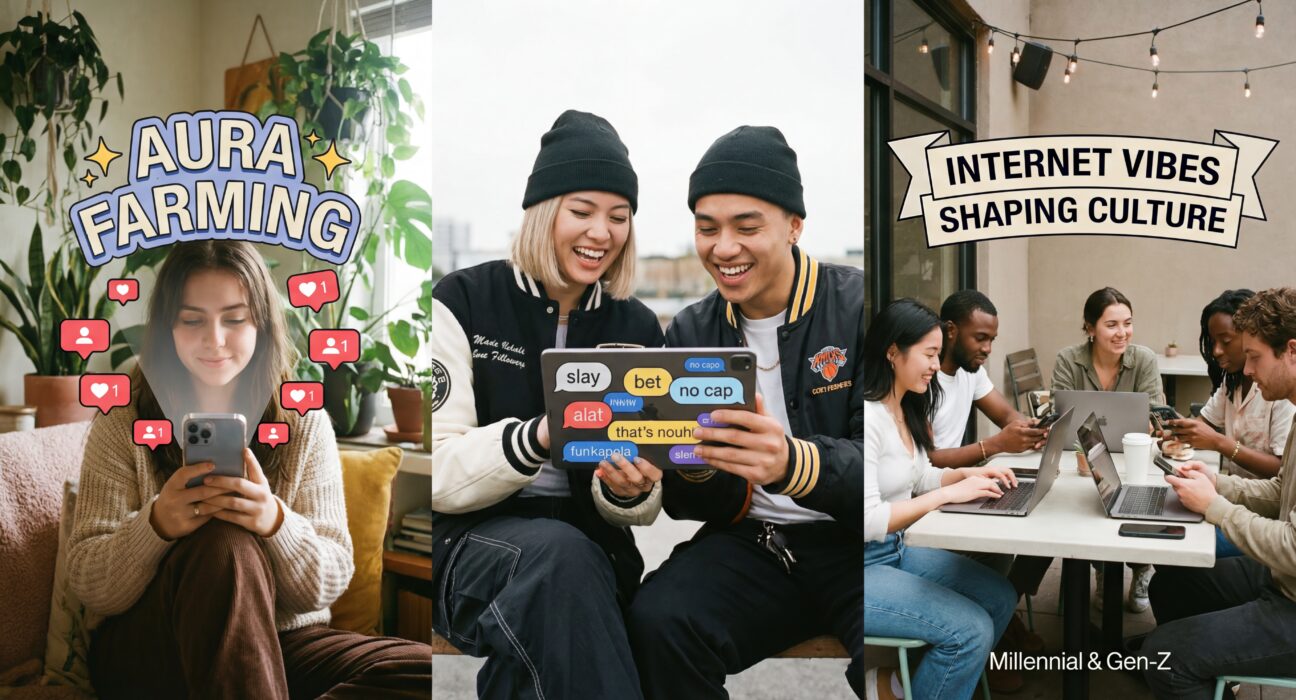
At its core, aura farming is the curated cultivation of your personal energy online. It’s the subtle (or sometimes not-so-subtle) ways people manage how others perceive their presence—usually on TikTok, Instagram, and Twitter/X.
Think of it like this: if your social media presence is a garden, aura farming is the act of planting only flowers that match a certain aesthetic, trimming the weeds, and occasionally sprinkling glitter over the soil.
Examples of aura farming in action:
- Posting “effortless cool” photos at sunrise to suggest spontaneity
- Sharing book quotes that scream intellect without saying a word
- Using color palettes in posts to create a cohesive mood
Why it matters: Millennials and Gen-Z aren’t just scrolling—they’re absorbing and imitating vibes. The internet doesn’t just distribute information anymore; it distributes personality, energy, and aesthetic. Your “aura” can be quantified through likes, shares, comments, and your audience’s subconscious perception of you.
Viral Slang: More than just words
Slang has always evolved with culture, but social media has turbocharged it. A single term can blow up globally in days now, traveling from TikTok captions to Spotify playlists to text messages faster than any linguistic shift in history.
Examples you’ve definitely seen:
- “Main character energy” – embodying confidence, self-focus, or unapologetic presence
- “Cheugy” – pointing out what’s uncool without needing a dissertation
- “Hits different” – describing a feeling or experience uniquely impactful
- “Vibe check” – assessing someone’s energy, personality, or mood
These aren’t just words—they’re cultural contracts. Using the wrong slang at the wrong moment can instantly mark you as out-of-touch, while mastering it signals belonging.
Why aura farming and viral slang are linked
Here’s where it gets interesting: the language we use online is a direct reflection of our cultivated “auras.”
Viral slang is shorthand for a vibe.
- “Main character energy” isn’t just a caption—it’s a declaration of self-branding.
- “Hits different” is less about literal meaning and more about emotional resonance.
Essentially, Gen-Z and millennials have learned that words, images, and content style are inseparable. You can’t just post a cute picture—you need the caption, the tone, the timing, and yes, the slang, to maximize the aura.
It’s performance art disguised as casual posting.
The psychology behind it
Millennials and Gen-Z are hyperaware of curation, perception, and social signaling. There are a few reasons why aura farming resonates:
- Digital self-expression replaces traditional markers.
When your friends can’t see your closet, your house, or your face-to-face style choices as easily, your online persona becomes your primary expression. - Viral slang creates group cohesion.
Using the right words signals cultural literacy and belonging, almost like a secret handshake for your generation. - Auras act as social currency.
The “energy” you project online—through visuals, captions, slang, or mood—is now a measurable commodity. Likes, shares, and follows aren’t just numbers; they’re proof your vibe resonates.
A brief history of vibes: how we got here
Millennials kicked it off. You remember the days of “aesthetic Tumblr blogs” and ironic selfies. Then Gen-Z turned it up:
- TikTok accelerated everything—dance trends, sound bytes, aesthetic references
- Memes became semiotic shorthand for identity and emotional expression
- Slang started dictating visual language: a caption could literally change the aura of a post
By 2026, it’s no longer optional to consider vibes when posting. Your content either resonates—or it dies quietly in the algorithm.
The cultural implications
Aura farming and viral slang aren’t just trends—they’re shaping values, social dynamics, and even mental health.
1. Identity as a performance:
Social media makes identity performative in a way previous generations didn’t experience. We curate ourselves like gallery exhibitions. This can be exhilarating… or exhausting.
2. Language evolution accelerated:
Words now spread faster than ever, but they also vanish faster. Slang that’s viral in January can feel archaic by March. Your cultural literacy must be constant and adaptive—or you risk irrelevance.
3. Emotional literacy disguised as humor:
Many viral terms reflect emotional nuance—“hits different,” “cheugy,” “vibe check.” This is not shallow. It’s a subtle evolution of emotional intelligence expressed digitally.
4. Subtle social stratification:
People now judge each other on aura alignment and slang fluency. A single post that fails a vibe check can make someone feel disconnected, proving that digital culture has its own social hierarchies.
Aura farming in practice: a day in the life
Let’s make it real. Imagine you’re a 22-year-old creator posting on TikTok:
- Morning: You film yourself drinking coffee in soft morning light. Caption: “Main character energy .” You’ve just aura farmed calm, effortless productivity.
- Afternoon: You scroll memes, find a trending slang phrase: “This hits different.” You incorporate it into a caption for a video remix. Immediate audience alignment.
- Evening: Someone comments, “vibe check failed .” You respond playfully, reinforcing your aura as approachable but in-the-know.
Every interaction is a micro-strategy in vibe cultivation. And audiences? They eat it up.
The role of memes
Memes are aura farming accelerants. Why? Because they:
- Condense complex feelings into digestible visuals
- Spread rapidly, aligning individuals with cultural moods instantly
- Serve as shorthand for identity without needing explanation
Think about how “brainlet” memes, “NPC energy,” or “Cheems” expressions convey entire generational attitudes in one image. Memes are the glue that connects aura farming with viral slang.
What this means for brands
Brands that ignore aura farming are invisible. Those that embrace it? They risk misalignment—but can resonate powerfully.
Good examples:
- Microbrands using Gen-Z slang authentically
- Campaigns adopting “vibe over polish” visuals
- Content that feels participatory, not just broadcast
Bad examples:
- Forced slang attempts (“we’re so cheugy you guys lol”)
- Overproduced campaigns pretending to be casual
- Misreading cultural energy, leading to backlash
Brands now have to understand not just what people want, but how people feel. The aura matters more than the product.
The dark side of aura farming
It’s not all aesthetic rainbows and viral slang joy:
- Exhaustion: Constant self-curation and trend-tracking can be mentally draining.
- Exclusion: People not fluent in viral slang can feel alienated.
- Performative social interaction: Authenticity can become performative if every gesture is calculated.
Aura farming and slang aren’t inherently harmful—but the pressure to maintain a digital vibe can become overwhelming, especially for younger users.
Looking ahead: the future of vibes
If current trends hold, we’ll see:
- Hyper-personalized digital auras: AI tools may help users craft moods without losing authenticity.
- Slang as cross-platform currency: Words will bridge TikTok, Discord, Twitter/X, and Instagram seamlessly.
- Emotional tracking metrics: Platforms might even quantify aura resonance—measuring whether someone’s vibe lands with an audience.
In short: vibes will become even more central to identity, communication, and social hierarchies online.